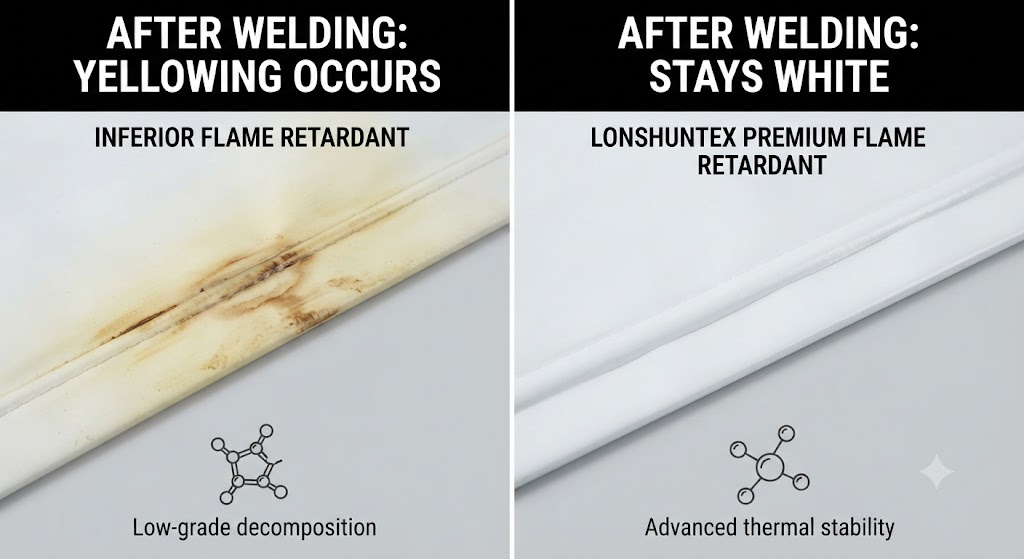
White tarpaulin welding yellowing is a persistent challenge for many in the industrial textile sector. For manufacturers and end-users, the integrity of a weld is not just about strength—it’s about maintaining a clean, professional aesthetic. We have frequently received feedback from customers encountering this frustrating issue where high-quality materials turn yellow or brownish after high-temperature welding.
While some competitors’ products suffer from this unsightly discoloration, Lonsuntex materials maintain their pristine white finish. Here is a technical breakdown of why this happens and why we refuse to compromise on quality.
Understanding White Tarpaulin Welding Yellowing: The Root Cause
The “yellowing” or “browning” effect often associated with white tarpaulin welding yellowing during the industrial process is rarely a random occurrence. It is almost always a sign of thermal instability, primarily caused by the choice of flame retardants used in the PVC formulation:
- Low-Grade Flame Retardant Decomposition: Many low-cost flame retardants (such as certain inferior brominated compounds) possess poor thermal stability. When subjected to high-frequency welding temperatures—often exceeding 150°C–200°C—these molecules begin to degrade, oxidize, and release acidic impurities that burn the material from the inside out, manifesting as yellow or brown streaks.
- Poor Compatibility with Matrix Materials: In the quest to reduce costs, some manufacturers utilize additives that do not integrate well with the PVC resin. Under high heat, these additives tend to migrate or cluster, resulting in uneven discoloration spots.
- Lack of Heat-Stabilizing Synergists: High-performance tarpaulins require advanced stabilizers to maintain color and structure during thermal processing. Cutting corners here leads to a “sacrificial” material that loses its structural and visual integrity under heat.
The Lonsuntex Commitment: Eliminating Yellowing
At Lonsuntex, we believe that a tarpaulin is only as good as its weakest component. We have observed a trend in the industry where manufacturers replace high-performance flame retardants with cheap, unstable alternatives to survive price wars. Lonsuntex will never join that race to the bottom.
- Premium Thermal Stability: We exclusively use high-grade, eco-friendly flame retardant systems specifically engineered to withstand extreme welding temperatures. This ensures that even under repeated or prolonged heat, our white tarpaulins remain bright and clean, effectively solving the problem of white tarpaulin welding yellowing.
- Zero-Compromise Sourcing: We have maintained long-term relationships with top-tier raw material suppliers. We do not swap our additives for cheaper alternatives, regardless of market volatility. Our formula is built for durability, not for short-term cost-cutting.
- Rigorous Weld-Testing: Every batch of Lonsuntex fabric undergoes stringent “extreme welding” testing to simulate the most demanding industrial applications. If it doesn’t stay white, it doesn’t leave our factory.
Industrial Standards and Best Practices
To ensure the best results in industrial applications, it is essential to follow standardized testing methods. Professionals often refer to guidelines provided by ASTM International for plastic performance, or consult the Industrial Fabrics Association International (IFAI) for industry-wide best practices regarding textile maintenance and welding safety. Using high-quality, stable materials is the first line of defense against long-term degradation.
FAQ: Frequently Asked Questions
1. Can white tarpaulin welding yellowing be prevented by adjusting machine temperature?
While lowering the temperature might reduce immediate browning, it often results in weak, unreliable welds. The permanent solution is to use high-quality, thermally stable fabrics like Lonsuntex, which are engineered to resist discoloration regardless of the welding parameters.
2. How does Lonsuntex ensure consistent quality?
We implement a rigorous batch-testing protocol. Before any fabric leaves our facility, we subject samples to accelerated heat stress tests that far exceed standard welding conditions, ensuring your projects remain pristine.
3. Why is thermal stability so important for industrial textiles?
Industrial textiles are often exposed to harsh environments, including UV radiation and extreme heat. Products lacking proper heat-stabilizing synergists will not only turn yellow but will also lose their tensile strength prematurely, leading to increased maintenance costs.
Why Choose Lonsuntex?
Choosing Lonsuntex means choosing peace of mind. By eliminating the risk of discoloration, our partners save time on rejects and gain trust with their own end-customers. You are not just buying a fabric; you are investing in a product that maintains its aesthetic and structural value under pressure.
Experience the difference that quality engineering makes. Contact Lonsuntex today for Technical Data Sheets and samples to see how we prevent white tarpaulin welding yellowing in real-world applications.